Submitting to the Mission

I’m reading Jim Collins and Morten T. Hansen’s new book Great by Choice where, for illustrative purposes, they compare the leadership styles of the two Antarctic explorers, the well-known Robert Scott and the lesser known Roald Amundsen, who raced each other to the South Pole. In particular, Collins and Hansen references Roland Huntford’s fantastic book The Last Place on Earth – Scott and Amundsen’s Race to the South Pole.
I read The Last Place on Earth in 2009 and immediately appreciated it as both an important historic account as well as a great study in leadership. It combines the two types of books I love to read – history books and in particular biographies of historic characters and books about real life adventure. The Last Place on Earth takes a historic look at one of the great adventures of all time – the story of the two men who raced to be the first to reach the South Pole.
I won’t repeat Collins and Hansen’s leadership lessons (you can read their book) but instead share one leadership observation and one conclusion I drew from The Last Place on Earth.
The observation – Scott ended up being the more celebrated of the two explorers though he failed in his mission which ended in his and his team’s death while Amundsen, the first man to the South Pole, is largely unknown outside of historical and exploration circles.
The conclusion – if a leader submits all, including their own personal ambitions and recognition, to the fulfillment of the team’s mission they’re more likely to be successful. At the same time they’re more likely to be unknown or forgotten because they made accomplishing the mission look easy while doing it with less drama than those who failed.
Keeping Your Eye on the Ball
 I grew up playing baseball, basketball and football (in which for many years I was a receiver). One of the most common instructions I’d heard from my coaches, regardless of the sport, was “Perry, keep your eye on the ball.” This meant, whether playing third base or wide receiver, to focus entirely on the ball until I had it completely in my control.
This instruction, on the surface, seems to be easy enough to follow, except for that linebacker ready to put a hit on me the moment I touch the ball, or the man on second base waiting to advance to third as soon as I made a throw to first. Then what became easy was to “take my eye of the ball” and try to see, at the same time, more than just that ball coming my way. When I did this it almost always led to me missing that ball and still getting hit or the guy still advancing to third.
Keeping my eye on the ball required discipline, focus and courage. It’s probably why I heard so often my coaches yell “Perry, keep your eye on the ball” and why it’s now burned forever into my consciousness.

Looking back I’m thankful for my coaches’ consistent instruction and the fact that their words continue to be front of mind now that the “sports” I’m participating in have changed and become more significant. Mishandling the ball, be it SpringHill’s mission, vision and values, the stewardship of my health, my role as father and husband or my relationship with Christ, has significantly more serious consequences than that ground ball that went through my legs.
And it requires even more discipline, focus and courage, three qualities I continue to ask God to provide so I will never take my eye off these important balls.
The One Quality Every Enduring Leader Possesses

I’m a student of leadership. I read leadership books, listen to leadership gurus and read leaders’ blogs. I’ve especially gained much insight by reading biographies of leaders from many fields, walks of life and historical periods such as Winston Churchill and Abraham Lincoln.
In addition, as a benefit of my work at SpringHill, I have the privilege of spending time with incredible leaders from many leadership contexts and places in the world. And over the last couple of months I’ve been with more leaders than usual which moved me to ask “is there something all these leaders have in common?”
Through all my study and observation I became convinced there’s one quality every effective and enduring leader possesses.
It’s that they’re intensely curious. They desire (and maybe more accurately “need”) to learn and grow as people and as leaders so they can lead their organizations better and see those they lead grow as well.
I can’t think of an effective and enduring leader I’ve studied, seen or interacted with that didn’t have this quality as part of their being.
Just as every leader’s different, this quality – the desire to learn and this intense curiosity’s expressed differently.
Some leaders learn through experience such as benchmarking other organizations.
Most leaders read, which explains why the cliché “readers are leaders” resonates as true.
Many use coaches, mentors and other advisors to help them learn, grow and improve.
Yet regardless of the method of learning this quality’s still the same – they have this intense curiosity and an endless thirst to learn.
And for this reason it’s also the one quality that I will fight to have in my life for as long as I live.
The Moses Temptation in Creating Vision

There’s nothing more heroic than the leader who goes off to some lonely place and comes back after an extended period of time with a clear vision for the organization and people they lead.
It’s what I call the Moses temptation of vision creation. In the Moses temptation the leader believes he or she’s to go off to the mountain, meet God, receive divine direction and return to the people with a vision so solid and unmovable that it’s written on tablets of stone.
When God used this process with Moses the results were stunning – a set of 10 “laws” which are still the basis of much of the today’s legal system. Yet it’s also the root of the Moses temptation – believing we’re Moses and our vision’s equal to the Ten Commandments.
But the issue for lesser yet important visions and their creation is that the process doesn’t allow for dialogue and debate necessary for building a committed team of stake holders. How can you debate a message from God “engraved in stone”?
Transparent, honest and humble dialogue’s necessary if stake holders are to have true buy-in and a long-term commitment to a vision. It’s not enough for an organization to have a charismatic leader who can inspire followers for a season; sustainable vision requires a sustainable community of people whose commitment’s built on their involvement in a vision’s creation.
And one last thought. Doesn’t a truly inspiring vision, one that compels us to long-term sacrifice, need to be significantly larger than a single person? I know I want to be a part of and lead an organization with a vision bigger than any single person, including me.
What about you? What’s your take on the Moses temptation? What kind of vision inspires you to a long-term commitment to seeing it through to reality?
The Rule of “Last”
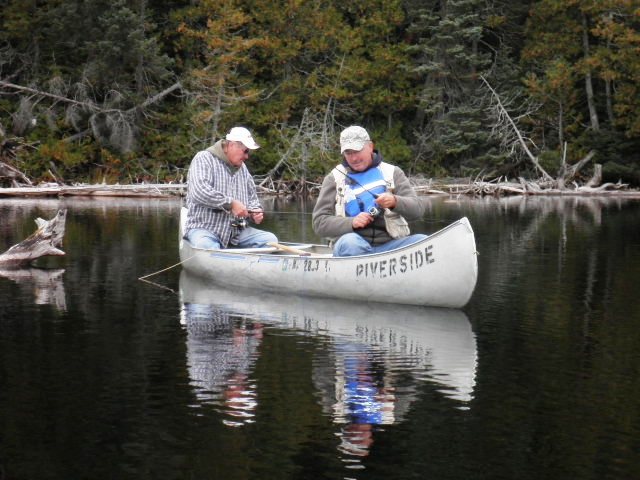
David Lynema (left) and Randy Boike “Just one last fish and we’ve caught our limit.” Randy Boike, David Lynema and I knew we were pushing the edge of getting back to the lodge in day light. If we stayed too much longer we’d be in the dark for part of our 2.5 hour return trip which included crossing 5 lakes, shooting 2 narrow rapids and making 2 long walks through the woods.
But we wanted to catch “just one last fish.”
Maybe not the safest decision when you’re in the northern Ontario bush.
And it’s especially not good when catching that last fish leads to an unplanned swim in a very cold Canadian lake, at the end of a very long day, at the end of September.
But that’s what happened on the last day of the SpringHill fishing trip. I caught the last fish, a big one (and it gets bigger every day). As I was lifting it into the canoe (I was solo) it tipped and I ended up in a very cold lake wearing way to much cotton.
Thanks to the cool heads of Randy and Dave and the inflatable vest Denise has sworn me to wear when I’m fishing in a canoe I ended up rescued, dried and warm before anything serious happened.
The whole thing turned out to be a humorous adventure rather than a disastrous event, for which I’m grateful.
But I couldn’t help recalling the rule my friend John McAuley instituted at his camp, Muskoka Woods, called “the rule of last.”

Whenever his staff hears “just one last time?” or something similar, they’re to make sure that the “last time” doesn’t happen. Why? Because their experience tells them it’s that “last time” when many accidents occur.
And I now know this rule’s universal and should apply to fishermen as well especially when they say “just one last fish”.
Fishing or Golf?

I come from a golfing family so I “played” golf for many years. But I also come from a long line of fishermen, so fishing’s always been a part of my life.
But 15 years ago I came to the conclusion that I didn’t have the time to do both. I needed to make a Solomon like judgment – golf or fishing?
But the truth was it really wasn’t much of a decision once I got over the fear of telling my family and golfing friends I would no longer be part of the club, both literally and figuratively.
Why did fishing win over golf so easily?
For starters I’ve never been very good at golf so I find playing very frustrating. Being with family and friends is always fun, playing golf isn’t.
On the other hand I’m never frustrated when I’m fishing. If the fishing’s bad then it’s the weather, the fish or the lake’s fault, but it’s never my fault. So I’m never frustrated. When I catch fish, whether it was simple luck or my fishing skills, it’s always a bonus.
Fishing provides the same opportunity for fellowship as golf, except you’re in a boat and not a golf cart. But the level of concentration required in fishing’s significantly less. As a result I’ve had some of the best life discussions ever while fishing.
And as I stated in my previous post, I love being outdoors, but I prefer to always be in the “wild” versus the “manicured” outdoors. Fishing provides the opportunity to be in the “wild”.
Finally, related to being in the wild, I love adventure and fishing’s always an adventure, or at least I tend to make it one.
So Solomon’s wisdom proved right, yes golf’s good, but for me, fishing’s better.
Creation’s Calling

When this blog posts I’ll be in one of my favorite spots in the world for a week of fishing with two groups of friends at Camp Anjigami in northern Ontario.
Besides the great friends and the very cool lodge I’m staying at, the opportunity to be out in “God’s creation” reaches my soul in ways I’m never quite able to express nor do other environments seem to do.
To live, even for a few days, in a wilderness setting reminds me of the vastness of our world and the greatness of the God who created it, providing perspective I’m so prone to lose while running hard through my daily life.
When I’m in the wilderness I experience God first hand. The theologians call creation “general revelation” because God’s character’s revealed in it. This explains why the purer and more pristine the wilderness setting the more I sense God directly and why my soul so loves and needs it.
So this week…
when I’m looking at the stars on a clear night that burn so brightly they reflect off the glassy lake creating the illusion that there are two skies…
or I smell the sweetness of the forest filled with freshly fallen leaves and spruce trees…
or listen to the sound of rushing water…
or, as I’ll work so hard to do, hold an incredibly beautiful brook trout in my hand for just a few moments…
I’ll have experienced God in a life transforming way.
And then I’ll be ready to return to the regular life I’m called to, better for having taken time in God’s creation.
Is It Worth Going on Vacation?

Have you ever wondered if it’s really worth taking a vacation? I’m a day away from my annual Canadian fishing trip with some close friends and I’m doing double duty to get everything done. So I hate to admit it, but I’ve asked myself more than once – is it worth it?
Of course my answer’s always “absolutely YES!” I can’t imagine not being with my closest friends doing something I love to do in a place I love to be.
So then I ask a follow-up question – “what do I absolutely need to do to go on vacation so I’m not worrying about what I didn’t get done?” My answer’s the first step in getting ready to leave.
The answer’s also important because I won’t have any cell service or email so there’s no chance to do any leftover work. And I’ll be mad at myself the entire vacation if I’ve planned so poorly that I have to bring work with me.
The next step is to create a prioritized “Before I leave for vacation” to-do list and then work on it the two weeks before I leave. The list includes SpringHill work, family commitments, trip preparations and other obligations.
I then prioritize the list into two categories. The first is “the stuff that absolutely needs to be done before I leave” and the second category’s the ever-growing “stuff I would like to do before I leave”. You know which one I work on first.
The list does a few things for me. It keeps me focused. It provides my assistant Katie and my wife Denise an idea of what balls that might come their way while I’m gone. And finally the list’s essential as a starting point when I’m back.
So yes, vacation’s worth the work, but I couldn’t be ready without my to-do list.
9/11 – I Remember Where I was when…

Historic moments burn deep images into the hearts and minds of a generation that witnesses them. That’s why anyone alive when the Japanese attacked Pearl Harbor or lived through the assassination of President Kennedy remembers exactly where they were when they heard the news.
It’s why a new generation will never forget where they were when harrowing news arrived on September 11, 2001.
I remember where I was when I heard the news of the first plane crashing into the north tower of the World Trade Center. I was sitting at breakfast at a small diner in Midland, MI with a small team of SpringHill staff and volunteers. We were doing our last run through of a presentation for a significant grant we were seeking from a major foundation.
Because I’d been in my role as SpringHill’s President for only 90 days and with this grant on the line I became focused on the task before us. During our discussion one of our teammates received a phone call from his wife saying a plane had just flown into one of the World Trade Center towers.
Frankly, I quickly shrugged it off as a horrible accident and continued leading our team in the preparations for this important presentation.
But then we got the second phone call about the second plane that crashed into the second tower I knew that something significantly more important than our presentation just happened.
In the midst of this unfolding news we made our presentation to the foundation and received one the largest grants in SpringHill’s history.
But truth be told, I will always remember where I was on September 11, 2001, not because of the incredible grant we received, but because of the images of this historic, life altering event, which are now burned into my heart and mind – forever.
The Underappreciated Work of Making Vision a Reality

We’re enamored with strategic thinking and vision casting. Most leaders want to be seen as strategic and visionary thinkers who cruise around at 30,000 feet. We value this skill set so much that we make heroes out of these same leaders.
But I’m convinced that being just a visionary leader isn’t nearly enough. Now don’t get me wrong I’m not minimizing the importance of these skills – creating strategy and vision need to be a part of any leaders work. Too often, though, leaders spend too much energy on vision and strategy and too little energy on tactics and execution.
We often look down on tactical work and the execution of strategy because we misread people like Steve Jobs and credit Apple’s success to his vision and strategic thinking.
But if you’ve read any of the 100’s of recent articles and blogs about Jobs after the announcement of his retirement as CEO you see a different picture. What you find is a leader who spent much of his time in the “trenches” working on the details of new products – in other words doing the tactical work. This is what made Jobs truly visionary. It was his willingness to do the hard, everyday work required to assure that his vision and strategy succeeded.
So as a leader my goal’s to spend only a small percentage of my time on vision while spending most of my time working side by side with our staff, board, supporters and volunteers in the hard work of making our vision reality. Because at the end of my time at SpringHill, if anything’s written about me, I want it to be said, not that I was just a visionary, but that I led an organization that turned its vision into a world transforming reality.


