The Culture of Opinion

Over the last few months I’ve traveled 90 minutes to and from Grand Rapids on a weekly basis. As I started this routine, I turned to the local sports talk radio for my on road entertainment. But within a few trips I grew weary of listening to the callers spouting off with their opinions about local teams, coaching decisions and player performance.
I grew weary because I had just come off of 5 years of coaching middle school and high school sports and I had discovered that there’s much more to coaching decisions than what the average fan sees during a game. I came to appreciate that coaches have significantly more information about their players and their team than any person could conceivably gain just by being a fan.
And what made sports talk radio even more wearisome was simply that most of the callers had so little experience playing or coaching, and none at the highest levels, yet felt they could, with authority, criticize coaches and players. They seemed to ignore the obvious fact that those they criticize have significantly more knowledge, experience and ability than all the callers combined.
Yet this culture of opinion isn’t limited to the world of sports. It’s in every facet of our society including politics and business. So as I listened during those first few trips I realized I no longer want to be filled with a litany of uniformed and inexperienced opinions, instead I need facts and perspective that I can trust, value and act on (such as a good interview with a player or coach). And I also decided I will not be one of those people who criticize others, whether they’re close to me or far off, when I’m not capable of doing any better myself, and when I know I have significantly less information and experience than they do.
Calling the Audible

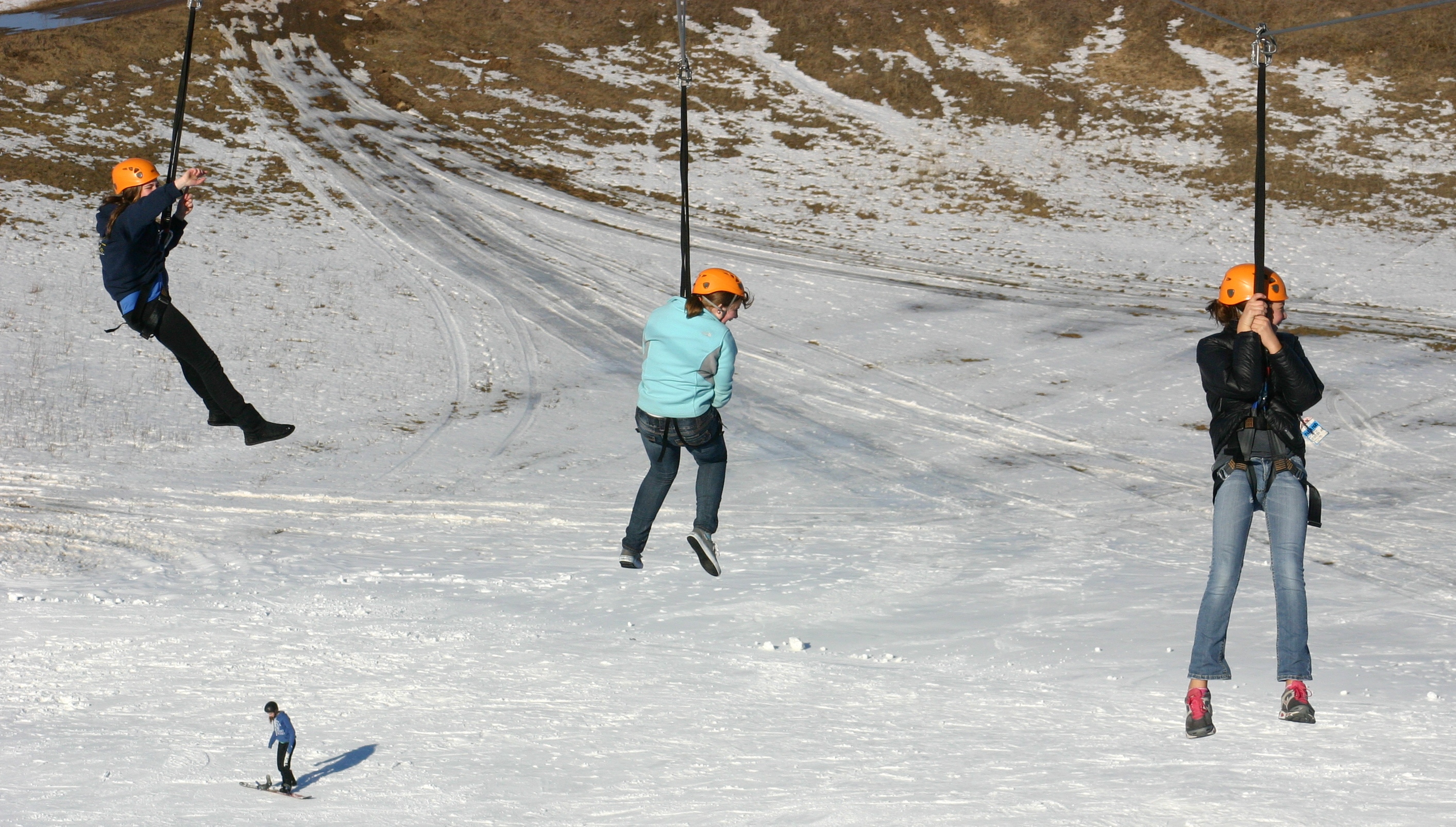
What do you do when you’re hosting over 900 students and their leaders for a “winter” retreat and winter melts away? In light of it being Super Bowl weekend, you call an audible.
That’s exactly what our Michigan Retreats Team did this weekend after days of warm weather melted much of our snow (except, of course, on our tubing hill) including an anticipated Saturday with temperatures in the mid 40’s. So the team decided to open up activities we normally offer during the non winter seasons such as riflery and, of course, the zipline.
As a result, for the first time in SpringHill Winter Retreat history, we have students racing down the New Frontiers zipline. It was an incredible scene watching 100’s of students speeding down both the tubing hill and zipline at the same time.

Sarah Gillespie and her team making it happen But what made me proud was how our team looked at conditions outside their control (the weather) and instead of bemoaning them, searched for a way to take advantage of them, to create an experience that exceeded our guests’ expectations. It meant a lot of extra work – opening up activity areas closed for the season and having staff trained and ready to safely operate them.
Yet the team still called the audible, because the conditions “on the field” warranted it. And the result was a memorable and life transforming weekend for over 900 students and their leaders.
What made an audible even possible? Simple, our team already had a well thought out and fine tuned plan. I’ve often heard people ask “why plan if we’re just going to change it?” Well, you can’t change what you don’t have, if you don’t have a game plan you can’t call an audible.

Former staffer and long time volunteer Nick Deck working the zipline And, as our team demonstrated this weekend, when you have a great game plan then you’re in a position to call an audible, and the right audible can change the outcome of the game.
The 360⁰ Evaluation
 Recently I initiated a 360⁰ evaluation of my leadership. I did it in response to a recommendation in the book What to Ask the Person in the Mirror and after discussing the topic with my peer learning group.
It’s important I understand my leadership strengths and weaknesses including any blind spots I might have. Knowing this information is especially critical in light of SpringHill’s current and future growth.
As I expressed to the folks I asked to participate in the evaluation, I do not want my leadership to be a hindrance to SpringHill reaching its potential. Because the truth is, the effectiveness of an organization is always less than or equal to the leadership capacity of its chief executive, never greater.
So if you’ve ever contemplated having a 360⁰ evaluation of your leadership, consider the following recommendations from my experience and the experience of my peers, in helping make the process more fruitful and productive.
- Have an outside human resources professional administer the evaluation on your behalf.
- Use a reliable and valid 360⁰ process. I used The Center for Creative Leadership’s evaluation tool. It’s proven and compares your feedback to a database of 100,000’s of leaders from around the world.
- Don’t make it part of your performance appraisal, it’s better used for developmental purposes.
- Initiate the review; don’t wait until someone initiates it for you. You want feedback sooner than later and not when someone (like your boss) thinks there might be an issue, because, in that case, it might be too late.
- Be open to all the feedback and be prepared to make changes.
Feedback isn’t always easy to get and receive, but as Proverbs 10:17 says “He who heeds discipline shows the way to life, but whoever ignores correction leads others astray.”
The Truth about Faith and Planning

In Christian organizations we often live in the tension between faith and planning. The tension comes because we believe faith and planning to be polar opposites.
Christian history is full of stories of “great people of faith” who did miraculous things for God. We want to be a part of such stories. On the other hand, it isn’t nearly as appealing to be part of a story centered on a cold and calculated plan, professionally executed. Instead we want to “let go and let God” and become part of a “miracle”?
We want to be like Peter who stepped out of the boat to walk on the water but too often we ignore Nehemiah’s thoughtful and intentional plan to rebuild Jerusalem’s wall, or David’s strategic vision and preparation to build the temple. Did David and Nehemiah have less faith than Peter? Or how about this question, would you rather walk on water for a few seconds or rebuild a city or build God’s dwelling place on earth?
I know my answer; I want to do something significant and lasting. And to do something significant and lasting requires planning, preparation and vision. And it also requires prayer (re-read Nehemiah) and faith (re-read David’s temple preparation).
Like Nehemiah and David, God has called us to be stewards of our time, resources, gifts and abilities. As a result, a good steward plans and then assures those plans align with their master’s intentions. And the beautiful thing is, the better the stewardship, the greater the opportunity of being a part of a miracle.
Therefore we need to stop seeing faith and planning as polar opposites, instead we need to see them as essential companions in our work. When we do this, God will do His greater work, allowing us the possibility of being a part of a miracle that’s significant and lasting.
The Blessings of Integrating Our Personal and Professional Lives

Saturday night Denise and I had a chance to bring parts of our two families together – our immediate and our SpringHill families. In particular we had 18 members of the SpringHill family from the Indianapolis area join us to watch our daughter Christina dance in her first Butler ballet – The Nutcracker.
We had dinner together at a local Butler hangout, Binkley’s, and then went to the evening show at Clowes Hall on Butler’s campus. For Denise and me the entire evening was a blessing and a blast.
Afterwards I thought about how so many people seek a separation between their work and their personal lives. I understand this desire but not always the degree people can take it.
Because there’s something wonderful (maybe sacred is a better word?) when there’s a healthy integration between our work and personal lives. It’s what Denise and I experienced Saturday night. We experienced a great blessing when SpringHill staff, board members and other supporters enthusiastically celebrated with us Christina’s first Butler Ballet.
And it turns out to be more than just one evening, because we have these incredible friends who now know Christina, live near her and will be available to her (and us) during the rest of her years at Butler.
And this would not be possible if I kept a strict separation between my work and personal life.
Yes, it’s healthy to be able to step away from our work, but to build artificial walls between work and personal life isn’t, and often keeps us from receiving the blessings of an integrated life.
To strike the right balance between these two parts of our life requires wisdom, prayer and reflection. But when the right balance is struck, as it was on Saturday evening, it’s hard to imagine living any other way.
Hangin with the SpringHill Family

We often talk about SpringHill staff as “our team” but when we speak about staff and camper alumni, volunteers, donors, ambassadors, board members and ministry partners we tend to speak in terms of family. The SpringHill family’s large and diverse and I’ve grown to love and appreciate it more every year.
Part of my work includes spending time with SpringHill family members both when they attend a SpringHill Experience and with them in their homes, their places of work and at their favorite coffee shops and restaurants. The places where we meet are as diverse as the members of the SpringHill family which makes being with them one of the most enjoyable parts of my work.
For example, this week I’ve had the opportunity, along with Todd Leinberger our Great Lakes Region Vice President and my wife Denise, to spend time with these SpringHill family members:
Scott, a successful commercial real estate business owner, a competitive tri-athlete and a very active member on a number of ministry boards
David (in photo above), who’s responsible for all the tire, wheel and jack engineering globally for Ford Motor Company
Paul and Cindie, long time friends of Denise’s and mine from our church in Grand Rapids. Cindie works with teenage moms and Paul owns a wealth management and financial advisory business
Our friends Scott and Karen who’ve given much of their lives to a number of global ministries and businesses
And later this week Denise and I will have dinner and see Butler University’s Nutcracker Ballet with 18 of the SpringHill family in Indianapolis (look for my next post)
Every time I have coffee, lunch or dinner with a SpringHill family member I’m blessed because I learn something new, gain greater perspective on SpringHill and better understand the world in which the SpringHill family lives and works.
Qualities of Trustworthy Youth Organizations

Denise and I hold two important, but at times conflicting, goals in raising our children. The first one’s simply to assure our kids have experiences that help them grow physically, emotionally, socially, intellectually and spiritually. Secondly, we want to do all we can to keep our kids safe and to protect them from the consequences of evil.
It’s when we need to entrust our children and their safety to those who provide them life transforming experiences that we can feel conflicted. We want to provide our children these experiences and at the same time assure their safety.
The best way to achieve both is to verify that the organizations we entrust our children to have the following three qualities.
Transparency
The organization and its staff are transparent. Transparency mean’s there’s nothing hidden about its history, operations, philosophies, track record and methods. Transparency also includes our child’s experience.
Accessibility
Related to transparency is accessibility. Organizations and staff are accessible to parents. In addition, if necessary, our kids are accessible when involved with the organization. We should expect our phone calls and emails to be returned timely as well as the opportunity to meet the staff when dropping off and picking up our child as well as any other time we want to interact with them.
Professionalism
Professionalism includes a broad range of key activities that we should expect from an organization and its staff including verifiable training, quality control, safety practices and policies that the staff know and demonstrate commitment to by their adherence to these policies.
These three qualities should permeate the entire culture of an organization as reflected in the staff, websites, promotional material and most importantly in their reputation.
With prayerful due diligence, we as parents, can reduce the possibility of any harm coming to our children and yet still provide them those formative experiences they so desperately need to reach their potential.
Intersection of the Past, Present and Future

My high school Young Life group at Wilderness Ranch There are those moments in our lives where our past crosses our present as it moves towards the future. It’s in those moments of intersection that God provides a glimpse into how He’s orchestrating our lives for a purpose we may have never seen or anticipated.
I had one of these moments this past week when I had the opportunity to speak with Young Life’s Camping Department about leadership, professionalism and the current state of Christian camping. It’s an intersection because of the significant role Young Life’s played in my life.
I’m a Young Life kid meaning I attended Young Life club, campaigners and camp as a high school student. Next, my wife Denise and I served seven years as volunteer Young Life leaders. Then I moved into involvement on Young Life area committees before stepping back because of family and work commitments.
Young Life’s played an enormous role in my spiritual, emotional and leadership development as well as influenced my personal philosophy of ministry. So when I was asked by Steve Thompson, Young Life’s Vice President for camping, to speak to his team, an intersection of my past and present occurred.
But it’s also an intersection of the present and the future because of the continued need of Christian camps and other youth ministries to work together to serve young people. Because of the world in which we live and the culture we’re called to work, I’m convinced the future of effective ministry to young people will require the cooperation of like-minded organizations such as SpringHill and Young Life.
This week my past intersected with my present, but it’s to the future where I’ve now set my eyes and will continue to take steps on the path God’s graciously illuminated for me.
Focused Freshmen Bulldogs

Andrea and Christina This past weekend was quite significant for our family. Denise and I dropped off our daughter, Christina, for her first year at Butler University where she’s in the Jordan College of Fine Arts majoring in Dance Performance.
We did all the typical tasks one does when dropping off a child at college. We put her room together, met and spent time with her new roommate Andrea, toured campus, attended events designed to welcome students and their families and went to the bookstore so I could buy a Butler hat.
During a “meet and greet” of department faculty, Denise, Christina, Andrea and I talked with one particular Ballet professor who asked Andrea “what’s your major?”
“Pharmacy” answered Andrea.
To which the professor said “well you will not seeing Christina during the day because she’ll be training.”
Andrea smiled and didn’t respond; she must have had that look that said “really, dancing all day long?” because the professor added…

Andrea and Christina embracing being Bulldogs “You see, if you want to be a professional you have to be fully committed, you can’t work at it part-time just like you cannot work at being a pharmacist part-time. There’s no part-time training; one has to be fully committed full-time to achieve such a goal.”
I’ve replayed this conversation in my mind since that meeting and I’m convinced that what this professor said is absolutely true. Whether you are pursuing a career in the arts or the sciences, to become a true professional requires more than just a part-time effort.
The realization then set in – Christina and Andrea’s room will be one focused place for the months to come because these two women have serious goals of becoming professionals in their competitive fields. What a gift…to have such focus at the age of 18.