A Centered Life
 Everyone centers their life on something. Whether it’s on a pursuit, purpose or goal, our lives become energized by our “center”. Some people center their life simply on surviving day by day, while others, on the opposite extreme, center their lives on consuming material goods, experiencing pleasure or living for excitement and highs. Yet others center their lives on an idea or a cause. But regardless of what it is, everyone’s life’s centered on something, something that drives them and gets them out of bed every day.
At SpringHill we expect our staff to be centered on a person – the person of Jesus Christ. Of all the personal qualities and professional competencies a person needs to have to make an ongoing, positive impact at SpringHill, this is the most important one, because it’s who we are and what we do. We call this quality “God Immersed”, which simply means that a person is Christ centered and thus living their lives in a Christ like way and from a Biblical perspective.
When you consider our mission and our core values this only makes sense. If our mission is to create life changing experiences where young people can know and grow in their relationship with Jesus Christ than our staff has to being growing in their own relationships with Christ. And if one of our organization’s highest values is “Jesus Christ and His message of grace”, than it needs to be a living value of our staff as well.
So what do we expect to see in a person’s life to know they’re “God Immersed”? It’s simply participating in such spiritual practices as prayer, Bible reading and study, as well as attendance and involvement in a local church. All of which leads to a Christ centered life that reflects Biblical and Kingdom values, and, in the end, multiplies the fruitfulness of our work.
This is part 5 of 14 in a series of posts about what it takes to be successful at SpringHill.
Wisdom Applied
 The test of our wisdom is found in the decisions we make. It’s displayed in the quality, timeliness, and the process in which we go through to make decisions. So it’s all three of these aspects of decisions – quality, timeliness, and process – that reflect the wisdom we have, or don’t have.
Wisdom requires knowledge, experience, judgment, and analytical ability, combined with a strong sense of right and wrong. And the measure of all these things, the proof that we have wisdom comes through in the decisions we make. Decisions are the tangible, measurable expression of our wisdom. Its wisdom applied.
It’s also why one of the personal qualities and professional competencies someone needs to possess if they’re to have long-term success at SpringHill is quality and timely Decision Making.
At SpringHill this competency is absolutely critical because of the freedom we provide our staff to do their jobs and the sense of stewardship we expect them to practice. It’s because we believe that the best people to make decisions are the ones closet to the “action”, not those sitting far behind the “frontlines”. We believe this to be true because those at the “front line” have the best perspective and expertise.
Thus when an organization keeps decision-making closest to the “front lines” it requires staff who can display wisdom through their Decision Making. And, if done right, this kind of Decision Making ends up being the best because it’s almost always faster and higher quality.
And the added benefit of entrusting decision-making to staff on the “front lines” is that they continue to grow in their wisdom and in their ability to make decisions, helping the entire organization continually become better and more effective in fulfilling its mission (it’s all part of Personal Learning I covered in the last post).
This is part 4 of 14 in a series of posts about what it takes to be successful at SpringHill.
Always a Student – The Essential Need to Learn
 When you learn, you grow and change, and when you grow and change, it’s almost always a result of learning. There’s an undeniable relationship between these concepts. So if a person or an organization wants to grow, whether it’s in a career, a relationship, or in their impact on people and the world, it almost always requires ongoing learning. Because the reality is growth and change will stall or burn out if not fueled by learning.
This is why one of SpringHill’s core values is to be a learning and mission-driven organization. Without learning we would not experience the necessary change required to grow in our influence, outreach and effectiveness in fulfilling our mission and achieving our long-term goals. As we often remind each other “if we’re not learning we’re dying.”
It’s also why one of the qualities and competencies a person needs to have long-term success at SpringHill is what we call “Personal Learning”. It’s that personal and professional curiosity and inquisitiveness which leads to continuous improvement in one’s self and in the organization.
Personal Learning is evident in people who read, listen to others, ask lots of questions, and seeks out other people and organizations to “go to school on”. It’s also evident in people who take mistakes, defeats, and crises and see them as opportunities to learn , grow, and change. Struggles are an ally to people who love to learn.
One of the tell-tale signs a person (and organization) embraces Personal Learning is that they’re humble. You see Personal Learning requires people who accept and acknowledge to others, and to themselves, that they don’t have it “all figured out” and never will.
So, as you can see, Personal Learning is an absolutely essential part of SpringHill, which also means it is an absolutely essential quality of our staff, board and volunteers, especially if, together, we’re to make an enduring impact on our world.
This is part 3 of 14 in a series of posts about what it takes to be successful at SpringHill.
Life is a Stool – Living in Balance
 My dad has always said that life sits on a 4 legged stool with one leg being work/career, another family, a third friends and service, a fourth being health and recreation, and the most important part of the stool, the seat, representing our faith. Dad says that for life to be in balance, for it to be the way it’s supposed to be we need all four legs and the seat. If we neglect or remove any part we’ve made balance nearly impossible and the entire stool, and our lives, become at risk of falling apart.
I’ve always appreciated my dad’s way of looking at life, partly because it makes sense and partly because I’ve seen he and my mom live their lives in this way with the result being they’ve been blessed as well as having blessed those around them.
It’s this life perspective and practice that we’ve discovered to be an essential quality of people who’ve made a long-term and an enduring impact on SpringHill’s mission. It’s what we simply call “Life/Work Balance”.
Without this balance, life quickly crumbles and one’s ability to make an enduring impact quickly diminishes. When balance is gone health, influence and impact quickly leave as well, only to be backed filled with burn out, broken relationships, and poor judgment. Because like a stool, every part is essential and needs to be in working order or it will negatively impact the entire stool.
So Life/Work Balance is absolutely essential for people to be at their best. And we want and need people to be at their best, whether it’s at home with their families, at church teaching Sunday school, or working at SpringHill.
This is part 2 of 14 in a series of posts about what it takes to be successful at SpringHill.
The September Whirlwind
 This has been the longest stretch I’ve had in three years between blog posts. I have no excuses except its September which means two things. First, September is when we transition out of our busiest season at SpringHill – summer – and move to catching up on all the things, both personal and at work, that didn’t get done during this busy season. Things like those pesky yard and house projects which I got started but now need to be finished before the snow flies.
Second (and the real reason for my sporadic posting) I went on two fishing trips to northern Ontario, Canada (Camp Anjigami) this month (I know you don’t feel a bit sorry for me on this one and, frankly, you shouldn’t). One trip was with a large group of SpringHill friends and other was with long-time friends from college. Both trips were excellent, full of fishing, food and fellowship but not a lot of writing (or sleep for that matter).
But I’m now back at it, thankful for the break, but also energized for the great fall ahead.
So here’s a few of my take-a-ways from this September –
- It’s always good to step away from regular routines or disciplines, even healthy ones like writing. Even a marathoner has a rest days.
- There’s something very special about being with good friends in cool places, doing fun, adventurous activities. It always gives me a deeper appreciation for my friends and for my life.
- Finally, going someplace and actually disconnecting from the world is incredible. Everyone should try it; it’s good for the soul.
So yes, God willing, I’m back in the digital saddle again and looking forward to writing about the life ahead.

Gaining “Buy In”
 It’s the start of the football season and if you follow it you’ve heard ongoing discussions about coaches beginning their first season with a new team. It seems that one of the most significant indicators of a new coach’s success is the “buy in” the players have in the new coach’s system.
It’s the same with every organization that wants to fulfill its mission, to be effective or just plain wants to win, leaders must move their team from a posture of compliance to one of commitment. Great teams need people willing to sacrifice and passionately pursue its plans, priorities and direction.
The question is – how does a leader gain “buy in” and have committed staff, not just compliant staff? The answer’s too long for one short blog post but here are a few essentials that I’ve discovered over the years.
First, you need people who want to be committed to something bigger than themselves. People who just want a job will never move to “buy in” but will always just go through the motions to keep their job.
Second, when you have these kinds of people on your team you need to treat them as thoughtful, committed adults, as partners in your organization’s work. People willing to commit to something bigger than themselves expect nothing less.
Finally, your organization needs to be about something worthy of a person’s commitment and passion. Its mission, values, vision and its impact in the world needs to be great enough for employees, investors and other constituents to be willing to sacrifice to see the organization succeed.
So you see buy in isn’t just about great coaches, it is about the right players and effective leadership, all working together for a cause the entire team believes in.
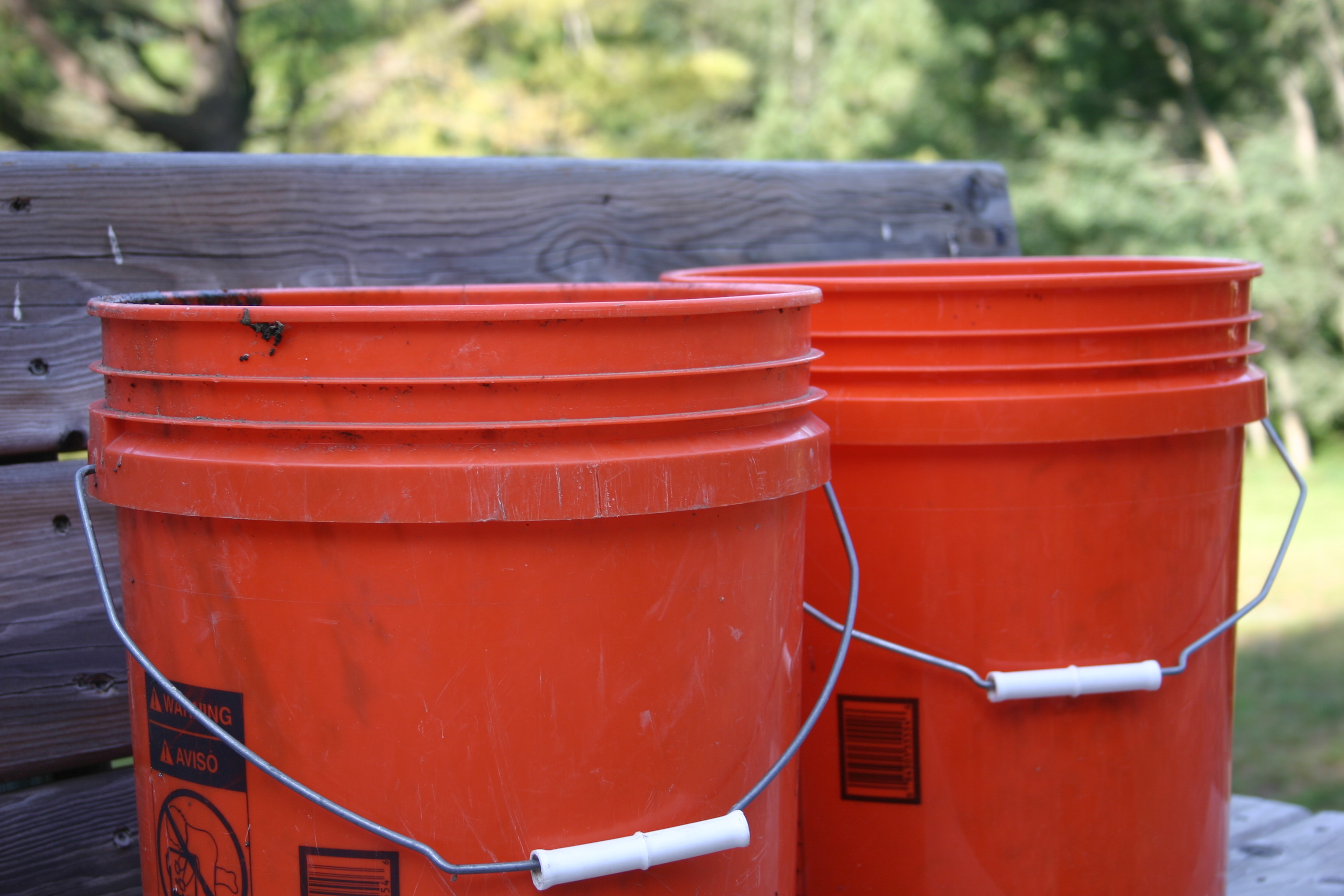
The Stupid Bucket and the Smart Bucket
 In one of our last summer staff meetings two of our summer camp directors, Jason Hoffer and Matt Casburn, challenged our staff to finish the summer strong. They did it by using a simple but memorable illustration. They told our staff “everyone carries around two buckets – the ‘smart bucket’ and the ‘stupid bucket’ – and every day we can take something out of one of these two buckets.”
The question they asked was “which bucket will you grab from during the last days of camp, the stupid one or the smart one?” The message to our summer staff was clear – you’ve been taking from the smart bucket all summer long, so don’t start grabbing from the stupid bucket in the last weeks of camp, meaning don’t start using poor judgment and making poor choices when all summer long you’ve used good judgment and made good choices.
And Matt and Jason, being the leaders they are, made this brief dialogue funny and, more importantly, memorable. So memorable in fact that, over the final days of camp, I heard numerous summer staff half-jokingly and half-seriously saying to each other “don’t take from the stupid bucket” or “let’s not do a stupid bucket thing”. Some of our staff even bought two buckets to remind every one of the two options they had before them.
It’s a sign of great leadership when you can give your team a warning or directive that isn’t threatening or demeaning, but instead funny, memorable, and effective because it gains your team’s commitment, not just their compliance. And even better is when the message is continuously repeated by your team creating a climate of self accountability and encouragement in making the right choices.
So what bucket will you take from this week?
The Uncomplicated Rule
 If you want to lose weight what’s the one best thing you can do? Take the stairs? Eat more grapefruit? Take diet pills? Lift weights? Run farther or eat better?
The truth is if you really want to lose weight there’s only one thing you can and need to do – eat fewer calories and carbohydrates than you use. As a personal trainer friend of mine once told me “you are what you eat”. Research has continually demonstrated that exercise programs, special diets, and supplements, though marginally helpful in losing a few pounds, will not, by themselves, bring you to your proper weight, only eating the right amount of calories and carbohydrates can you get to you there and stay there (though exercise has other essential health benefits we shouldn’t ignore).
It’s what I call the “uncomplicated” rule. The uncomplicated rule goes like this. Almost always the simplest, most straight forward and common sense solution to a problem is usually the best one. Why? Because most problems are not as complicated as many people (and companies) want us to believe. Simple problems, like being overweight, require uncomplicated solutions – eat less.
But why do we believe our problems are so complicated that they require complex and magical solutions? Because people’s problems are opportunities for marketers to offer products and services that solve our problems. But to convince us that need help in solving our problems they need us to believe our problems are too hard or complicated to solve on our own. You see simple, straightforward and uncomplicated problems don’t require complex and costly solutions but instead require simple ones (which don’t sell well and have poor margins).
So next time you’re faced with a problem or have a goal you want to achieve, look for the simple, straightforward and uncomplicated solution, most likely it’ll be the one that brings you to the place you want to be.
Some Lessons Learned the Hard Way about being Connected 24/7
 On any given day I have people contacting me by voice through my office phone and smart phone, via email accessed through my laptop, IPAD and smart phone, text messages via my smart phone, as well as people contacting me through Twitter, Facebook, LinkedIn,and on my Blog all accessed, as well, by my laptop, IPAD and smart phone.
This simply means, if I allow myself, I can be responding to people’s inquiries (in other words, working at my job) 24/7 on four different tools through seven different communication mediums (yes insane, but I have no one to blame but myself). So out of sheer necessity I’ve learned the following lessons and have incorporated them into my routine in an attempt to put some sanity into my work and personal life.
- First, when I’m off work, I don’t answer any of the above except for personal contacts and when I receive a text signaling an emergency at camp (we have a protocol for this).
- Second, when I’m on, I look at and respond to inquiries from all 7 mediums only 3 times day – first thing in the morning (usually between 5:30 and 6:30 am), after lunch and before I go home.
- Third, my goal is to respond within 24 hours except over weekends and vacations (I’ll admit I can do better on this one).
- Fourth, I don’t answer any inquiries from any mediums when I’m with people – be it meetings, meals, casual conversations, or on the phone. I think it’s inconsiderate and inefficient use of my time and the time of the people I’m with. My goal is always to focus first and foremost on the person, or people, I’m with.
- Finally, I prioritize my responses this way – phone calls first, followed by texted messages, then emails, my blog and finally Facebook, LinkedIn, and Twitter (so now you know how to increase your chances of a quicker response).
I’m not perfect at all of this, but when I’m disciplined in this way my life seems to have a bit more sanity and make a bit more sense.
The Lesson in Eclipsing 19,000 Summer Campers

“By the summer of 2019, 19,000 kids will attend one of six summer camps.” It was 1997 and the SpringHill board and leadership had just updated and approved the ministry’s strategic plan using Jim Collins and Jerry Porras’ book Built to Last as a guide.
Collins and Porras’ research revealed that enduring organizations had a “Big Hairy Audacious Goal” (BHAG). The “19 by 19” goal, as it was soon to be called, was SpringHill’s BHAGG (we added the first G – God – to our definition).
Now understand, in 1997 SpringHill’s board and leaders were people of talent and faith who wanted to do something significant for kids and Christ’s Kingdom. And the “19 by 19” goal reflected both this desire and the best information available to them at the time.
Yet today as I write, here in the summer of 2012, we just eclipsed this “19 by 19” goal. Please know I’m not sharing this with you so you can be impressed or congratulate us for handily beating our goal, but instead to demonstrate a point about goal setting that Collins and Porras doesn’t address.
In goal setting we tend to be overly optimistic about short-term goals and overly pessimistic about long-term goals. The main reason for this phenomenon is that we tend to think of the future only in the context of what we know in the present. For example, our staff and board knew and understood overnight camping but could not possibly have foreseen the dramatic demographic changes that would lead us to begin our Day Camp ministry nearly 10 years later (this ministry has played a significant role in our beating the 19 by 19 goal seven years early).
The lesson we learned, and then implemented in restating our BHAGG back in 2003 was that a visionary goal isn’t based on a “calculation”. It’s bigger than that, so big that we’d have no any idea how it would be achieved. The goal needed to be big enough “to leave room for God”, as one board member put it. Today our BHAGG is that, by 2025, we’ll have 260,000 people a year experience SpringHill.
Now, to be completely honest, only time will tell if we got this long-term goal setting thing right and whether the next generation of SpringHill leaders will judge us as fool hearted souls or Saturday morning sand baggers.