Week 1.8
Camps all over the country measure time during the summer by week number. If this is a camp’s sixth week of camp then it’s called “Week 6”. It becomes so ingrained in our language that we can slip into using this camp calendar when talking to people outside of the camping business.
SpringHill was no different until a few years ago when we started to re-think the perspective this calendar comes from and it’s implication to how we approach a week of camp.
We realized that the calendar, and it’s language, is from SpringHill’s perspective not the camper’s. For a camper, even though it may SpringHill’s Week 4, it’s still their first and maybe only week of camp.
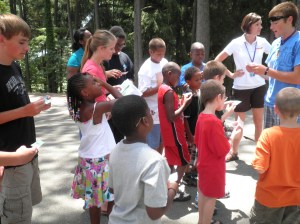
Opening day of Week 1.4 in Indiana. Kids are getting ready for a fire engine ride to their cabins. So we decided to change the language of our calendar to better reflect the camper’s perspective. It started with simply saying that every week of camp is Week 1. Implying we should approach every week with as much diligence and enthusiasm as we do that first week of camp.
Unfortunately we still had the need, internally, to know which week of camp we were in. So as good as the language “every week is Week 1 at SpringHill” was from a camper perspective it didn’t help us in managing our weeks of camp.
So by the end of that summer one of our staff figured a better calendar and calendar language. One that communicates both which week of camp we are in and which week of camp it is for our campers.
Thus was born the new calendar that every week is Week 1.camp week. Each week is a new version of Week 1. It captures both the internal need to track which week of camp we are in and also reminds us that this is the first week of camp for our campers.
So yesterday morning at our Michigan overnight camp’s summer staff meeting we ask “What week is it?” And the answer the staff yell back was “It’s week 1.8”. It’s our 8th week of camp, but more importantly for our campers, it’s Week 1.

Opening Day of Week 1.8, a little entertainment for arriving campers. Swimming in a Blue Ocean
Summer is one of the best times of the year for me to see and reflect on the state of SpringHill and to think about its future. All the interaction with campers, staff, parents and donors as well as time traveling creates a unique space that allows me to peer into the future.
One of the things I do when I am traveling is listen to audio books. And if it is a really a good book I will then also read through it. This summer that book is Blue Ocean Strategy by W. Chan Kim and Renee Mauborgne. It has been recommended to me by a number of folks over the last year including Craig Soderdahl our VP for Day Camps.
Frankly I put off reading it because I was sceptical that another book on strategy could provide anything new and helpful to me or SpringHill. Boy was I wrong.
It is the best business/management book I have read since Good to Great by Jim Collins . The premise of the book is that using the right approach to strategic planning you can “create uncontested market space and make the competition irrelevant.” By using case studies Kim and Mauborgne lay out a step by step process that outlines how an organization can create a “blue ocean.”
Reading the case studies themselves are both inspirational and illustrative and I have found myself continuing to repeat some of them as I have explained Blue Ocean Strategy to others.
If you are looking for a good summer read, one that might make a difference in your career or the organization you are a part of then I recommend Blue Ocean Strategy. And think about it, don’t we all want to be on a blue ocean during summer vacation?
No More Boring Staff Meetings
Monday’s always make me think of those weekly staff meetings I had when I was in the corporate world. Reality is most of them, though may have fulfilled their purpose, were boring and certainly did not ignite excitement and enthusiasm for the week ahead.
When I came to SpringHill I saw a whole new way to look at the “weekly staff meeting.” SpringHill’s weekly summer staff meetings are fun, inspiring and informational all at the same time. There is an almost a pep rally feeling to the entire meeting and for certain a great way to start a week of camp.

Three of our staff singing a song they made up for our high schooler campers and their staff (TST) So if you want to re-invent your staff meetings here are some suggestions, based on my SpringHill experience, on how you can take a weekly (or monthly) staff meeting and make it a kick off to a great week (month):
- Use music before and after the meeting.
- Have your most creative people put a plan together to share information in a fun and memory way.
- Build an agenda on the needs of the organization as well as input from the staff.
- Highlight and recognize staff as much as possible.
- Use laughter, even on more serious issues. People get it and will remember it.
- Allow the humor to flow naturally and not always be rehearsed.
- Use video, especially home done video with some of the team as the actors. Video is a memorable way to communicate ideas.
- In smaller teams food and beverages is always a plus.
- Save the serious moments for the truly serious stuff (if you don’t use serious moments often then they can be very impactful).
- Meetings should not just reflect the leader or leaders but the organization, who you are what you are about.
If you ever want to see one of our staff meetings, they are every Sunday mornings, 11:30, all summer long at either of our overnight camps. You are welcome to join us.
Facing the Ugly Reality!
Last night I saw one of those more graphic anti-smoking ads on TV where they show this procession of good-looking, talented people smoking. Then the last scene is of a deathly white man in a wheel chair with an oxygen tank telling us “this is what will happen to you if you keep on smoking”. So how do you watch this ad and then choose to keep on or start smoking?
Then two times this week I heard a version of “someone showed our church/organization a graph the projected what the number of members/people impacted by our work would be in 20 years. The projections said there would be zero.” Ouch! What do these two organizations do with such prophecies of doom?
Why is the ugly reality ignored? Because we don’t believe it, or we don’t like it, or we think it will never happen to us. So the likely future does not cause any change in us or our organizations and we become succesful only in making analysts into prophets.
Change, true transformation, always begins with facing the ugly reality including the likely end of the course we are on. Then stepping up and doing something courageous about it.
One church I visited this past week, Faith Church in Dyer, Indiana, did this, faced their ugly reality and over a 20 year period literally transformed itself. They grew from a church of a couple hundred people to a church of nearly 5000 on three campus’.
The second organization, a much larger organization full of rich history, heard the same type of projection. I sensed from one of the leaders within this organization, who shared the story with me, that the organization has not yet come to grips with this ugly reality. Thus they are doing nothing serious to change the course they are on. So the result will be, as predicted, that they will make another analyst a prophet and their only future reality to be found in history books.
We need to let analysts be analysts and face the ugly reality they provide so we can, instead, make their projections into catalysts for changing an ugly reality into a beautiful future.
The Power of Clarity
“Clarity of mind means clarity of passion, too; this is why a great and clear mind loves ardently and sees distinctly what he loves” Blaine Pascal. I saw Pascal’s thinking in action when I visited our Day Camp at River Oaks Community Church – http://riveroaks.org/ this past week . I had the opportunity to meet with Tim Rowland, Senior Pastor, and hear the vision and philosophy behind this effective Goshen, IN church.

Tim Rowland discussing the vision of River Oaks Community Church When I asked him why he believed our Day Camp partnership has been so successful in its first year (over 200 kids including 70 financially disadvantaged kids from local grades schools, fully underwritten by their church family). Tim responded that there was a clear match between SpringHill’s Day Camp ministry and River Oaks vision for its church community.
Tim then outlined, with ease and clarity, the vision of River Oaks and it’s people. First, that all their church family would, through their day-to-day lives, reach out to “lost” people around them. Secondly, that all their people would be growing in their faith in Jesus Christ and finally they would all demonstrate compassion for the poor and needy.
Tim then explained how Day Camps was helping them fulfill this vision in very tangible ways. Because of these tangible outcomes it created enormous passion and energy within their church family around this opportunity to make a life changing impact on the lives of 200 kids from their church and community. Thus the incredible success in their first year of hosting SpringHill Day Camps.
I loved the clarity Tim and River Oaks has for their church family. Because they have “clarity of passion” and a “clear mind” that “loves ardently and sees distinctly what they love” it allows them to make a decision to partner with a ministry like SpringHill and to follow through on that decision with the energy to make it a reality.
Speaking of clarity, we have a new portable ropes course that will be at a number of day camp locations (see below). It has proven to be a great challenge and a lot of fun for our campers as well as creating numerous teachable moments and object lessons that our staff can use to help reinforce the lessons we are sharing with our campers each day. Nothing creates clarity for people, regardless of the age, like having a tangible and hands on experience, such as a ropes course, to grasp and remember a lesson or spiritual truth.

Camper making his way through the high ropes course. 
Campers debriefing their high ropes experience (someone must have asked the counselor a hard question). My Summer Work + a Post Dinner Dance
With my first summer road trip starting today I have been reflecting on what I need to accomplish these next couple of months as I make the rounds to the different locations where we will be having SpringHill Experiences. Over the weekend, while looking through Newsweek, I ran across an interview with John Chambers, CEO of Cisco Systems Inc. that articulates nicely what my summer work needs to be.
Chambers, when asked how he was a different CEO today than when he started in 1995, answered this way –
“When I started, I viewed my job as three main areas: vision and strategy of the company, development and recruitment of the team to implement that vision and strategy, and the need to communicate all of the above. Within four or five years I realized that there was something that many of us do not understand when we take a leadership role: culture. Great companies have very strong and great cultures. A huge part of a leadership role is to drive the culture of the company and to reinforce it.” (from Newsweek, June 14, 2010, p. 46)
Chambers captures exactly what my summer work needs to be as I travel the mid-west meeting with staff, campers, parents, partners and supporters. I will be clarifying and communicating our vision, strategy and culture while investing in the people who make it all reality.
By the way last night at dinner in the New Frontier’s Dining Hall all of us diners were entertained to a post dinner dance by the TST team. A perfect ending to the first day of summer camp. Check out these photos.

New Frontier's TST Team Week 1 
The dance continues 
Vision and the “SpringHill Way of Life” Part I

My daughter Christina and I talking after she danced before our staff Sunday morning I had the opportunity to speak to our Michigan overnight and Day Camp summer staff teams about having a Godly vision for one’s life and how to achieve that vision. I had my daughter perform a ballet piece where she was on point a number of times and perform pirouettes as part of her routine. She was my illustration for the message. Here is the summary of the first part of my message to our staff:
Vision is a dream that you have a plan to achieve and then you work to that end.
Vision answer’s the “Be” question. Who do you want to be? What do you want to become? It’s qualitative in nature compared to be quantitive.
It’s what you see in your mind’s eye about who and what you want to be.
It’s also what others see in you, who they see you as. This factor becomes a test of whether we are fulfilling our vision- do others see this as well.
The “Be” question is different from the “Do” question in which we answer the question “what do we want to do?”, “what do we want to accomplish?” The “Do” question is the mission question and mission and vision are not the same thing.
Vision is about “being” and mission is about “doing”. Both questions are essential in our lives and our work but they are not the same thing.
Without vision we can not have mission, without the quality of “being” we cannot sustain any sense of “doing”. We run the risk of “doing” without integrity.
Yet to have vision without a mission is to risk being self-absorbed, to miss the calling God has on our life or the calling on the organizations we lead and serve.
My daughter’s vision is to be a professional ballerina. This requires an enormous commitment on her part, for her to live a “way of life” In my next post I will walk through the “SpringHill Way of Life” I shared with staff, it’s our way of helping staff achieve the vision God has for their and our lives.
Transparency
Today I met with Bill Payne, good friend, long-time SpringHill board member/supporter and Chief of Staff of Amway Corporation. Every time I meet with Bill we have an excellent conversation and I walk away being challenged and/or having a new idea or perspective on some subject.
Our conversation today ended up on the topic of transparency in leadership and within in organizations. We both acknowledged that transparency is essential to a healthy organization and for effective leadership. This led me to further thoughts on the necessity of transparency in leadership and within organizations. But first a definition of transparency.
Transparency is where one can see something clearly. Clear glass in transparent, frosted or dirty glass is not. When there is transparency there is nothing the hides or blocks ones view. We see things as they are with no distortion. With this definition in mind here are some thoughts about why we need transparency in our lives, leadership and organizations:
Where there is transparency there is:
- Trust – because everyone knows what everyone else knows.
- Accountability – which leads to better performance and higher personal integrity.
- Teamwork – because shared knowledge and information creates shared power and responsibility.
- Respect and appreciation for the work and lives of others.
- Truth is held in the highest honor.
Where there is little or no transparency there is:
- Lack of trust because where there is a lack of information people tend to assume the worst.
- Little accountability but instead unclear responsibilities, goals and expectations.
- Silos, in fighting, territorialism.
- Cynicism, back biting, gossiping and arm-chair quarterbacking.
- Where the truth is bent, massaged and manipulated to protect, hide and cloud issues.
When you look at the two lists it’s obvious which option is the best for our relationships, leadership and the organizations we serve, support and endorse. One might say there is risk to being transparent and in some cases there maybe, but the reality is that the risk is small compared to the risk on not being transparent.
We desperately need to be transparent as people then as leaders, followed by assuring transparency in the organizations we serve in, work for and support. It’s the foundation that our lives, our leadership and the organizations we serve need for reaching their full potential, doing and being all that God intend us and our organizations to be.
If you have some other qualities to add to one of the lists above please pass them on, we will add to the above list.


