Cranking the Pedals and Spinning the Summer Camp Tire.
 When I was a kid my friends and I’d turn our bikes over and stand them on their seat and handle bars. Then we’d spin the back tire via the pedals as we oiled the chain.
Invariably this act of maintenance turned into some type of competition.
We’d see who could get their tire spinning the fastest or the longest. We knew we hit top speed and the chain oiled just right when the momentum of the spinning tire would take the pedals right out of our hands.
But I also remember how hard we had to crank the pedals to start the tire spinning. The first 4 or 5 cranks were killers. But once we got it moving the tire would just spin on and on with much less effort.
Oiling the chain and those first cranks describe April, May and June at SpringHill. We are cranking the pedals to get the tire of summer camp spinning. We’re hiring our last staff, shoehorning in the final campers, finishing our curriculum and lessons, preparing and training staff and making sure the facilities, partners, and administrative components are all planned and ready to go.
People often believe that summer’s our busiest time of the year. And its true summer is extremely busy but it’s the oiling the chain and cranking of the pedals of spring which takes the most effort and energy. By the time summer hits the tire is spinning fast and our effort is on guiding and directing its spin.
So as our staff come off their spring breaks the race of getting the summer tire spinning is on. Please pray for us over the next few months that we have the wisdom, energy, strength and time to finish oiling the chain and cranking the pedals so the 2011 summer camp tire will spin fast, straight and smooth.
“What Would My Life Look Like If….?” Part 3
 I’ve been less than enthusiastic about working through my second “what would my life look like if…?” question. But it’s a question I’ve been confronted with on many levels over the last year so I’m compelled to deal with it.
Remember the second question is “what would my life look like if I committed to attending every funeral and wedding and visit the hospital for colleagues, friends and family? What would my life look like if I was really there for them in those times?”
This question raises the same issue I worked through with my exercise and eating right question. I’m a busy person so if I really want to I can always find a reason not to a attend funeral, wedding or visit the hospital.
But there is a difference between the two questions (know I’m being transparent here). I can see personal benefit in the exercise and eating right question but in this second question, on the surface, I see no real personal gain.
This is why I’ve been so convicted because it deals with my self centeredness. If I’m to be the person Christ has called me to be then I need to look beyond myself, to do and live for things that matter to others not just matter to me.
And who is that person? One who loves others more than the stuff on a to-do list and so endeavors to be a part of these important moments of their lives. And if I believe this is the kind of person Christ has called me to be then I need to trust that He will help take care of my to-do list.
So I’m committing myself to attending as many of these important events as I possibly can with the prayer that somehow it will be a blessing to others.
“What Would My Life Look Like If….?” Part 2
First question I’ve decided to deal with on vacation is “What would my life look like if I got back to a regular exercise routine and eating better no matter my schedule?”
I chose it first because it’s the easiest of the two questions I’m mulling over this week.
It’s easy because as I thought of the benefits to doing regular exercise and eating right I really have no good reason, just excuses, for not getting back to my exercise and eating routine.
Any reason I’ve come up with (and I’ve used them all over the last 6 months) have to do with the many seemingly “important” things scheduled during any given week.
So without repeating all the obvious reasons we all know for why we should exercise and eat right I will share with you just two that have convicted me to get back on track.
First, any short-term gain in time or convenience I have by not taking care of myself quickly robs me of needed energy in the short-term as well as hurts my health in the long run. The payoff for exercising and eating right is both immediate and long-term. When I picture my life both now and in the future I like the way it looks when I’ve taken care of myself.
Finally I just can’t get over that fact that God has given me a healthy body. I have or had no major illnesses or injuries. This is a gift from God and I feel a strong sense of responsibility to care for my body much more than I have. It’s a matter of stewardship and I’ve been a poor steward over the last 6 months.
So starting now I will make time in my schedule for exercise and make sure I make accommodations that allow me to eat right. It’s a change that will make my life look more as it should be.
“What Would My Life Look Like If…?”

When I’m on vacation I like to ask myself a series of “what would my life look like if…” questions. These are questions that, in theory, should help me live better and be more fruitful for the Kingdom.
For example I might ask “what would my life look like if I read a book a week for the next year?” or “what would my life look like if I quit eating junk food?”
Then I go about my vacation thinking and praying about each question by looking at the “upside” and the “downside” that each potential reality would create in my life. Sometimes I will write out a list but most often I just try to create a mental picture of what my life might look like with any of the potential changes.
I will also pray about each question while running with Denise, going for a walk or sitting by the pool. I ask God for His direction and guidance.
Then sometime during the week I will make a decision. I may pass on the change because the cost seems too high or I just don’t think it’s realistic with other things I’m doing at the moment.
If I decide to move forward, I will write down my commitment and then work out a plan. If I say yes then I want it to become a reality in my life.
This vacation’s two questions?
“What would my life look like if I got back to a regular exercise routine and eating better no matter my schedule?”
“What would my life look like if I committed to attending every funeral and wedding and visit the hospital for colleagues, friends and family? What would my life look like if I was really there for them in those times?”
Over my next two posts I will share my reflections and my answers to these questions.
On Being Lost

“Psychologists have observed that one of the most basic human needs, beginning at birth, is to be gazed upon by another.” Therefore, “part of the terror of being lost stems from the idea of never being seen again” from Laurence Gonzales’ Deep Survival – Who Lives, Who Dies and Why.
If you’ve ever been lost you know the truth of this statement.
As I’ve thought about this statement I’ve been struck by the very real relationship between being lost geographically and being lost spiritually.
No wonder the Biblical writers, pastors and theologians talk of being separated from God as being lost.
And there are few things worse than being lost. Because ultimately being lost means we are no longer “seen” thus no longer known. And this is an even more frightening thought when we think of it in spiritual terms.
Now the truth is we’ve all been lost, and to some degree, we are probably all a bit lost now in some part of our lives which is why we understand this deep need to be “gazed upon” by God.
So as I reflected on the meaning of “being lost” I’ve been personally convicted that I need to continue helping those who are lost and who desperately want to be “seen again” and be “gazed upon” by their Creator.
I’ve also become more convinced than ever of the importance of ministries like SpringHill that exist to help lost people become “seen again” by the One whose gaze changes everything. There is no greater gift to give or receive.
Space for Making Vision a Reality

The SpringHill leadership team has learned the importance and the formula for creating space for the planning necessary to make our vision a reality.
Our team just came out of such as space where we completed some good work thinking through our future organizational needs and design in light of our current (and expected) ministry growth.
What does this space look like for us?
- It starts with a smart and committed team of people with shared values and vision.
- To this end, as part of our day, we have dinner together just so we can hang out and catch up.
- We meet at an off-site location that can inspire new thoughts or perspectives. Today was at a friend’s home on Lake Michigan
- We do a lot of pre-work to assure the information, ideas, and the direction needed for the meeting are in people’s hands long enough for them to prepare.
- During our time together we assure everyone has the opportunity to speak and then we all listen.
- We use flip chart sheets so our ideas can be posted in front of us during the meeting.
- Assure an action plan’s created so our thinking becomes action.
- We meet once a month so the work doesn’t get lost or stalled.
- We always approach this process as an act of discovery.
- We pray together asking Christ to lead us where we ought to go and keep us from where we shouldn’t be.
If you lead a team or just lead yourself, create space to dream, plan and look ahead. You and your team will benefit greatly and the world will be a bit better as a result.
The Bittersweet Taste of Transition

Our oldest son, MD, just informed us that he’s been offered a very good summer job with his school Calvin College. This means he’ll not be home for the summer.
Which also now means, for all practical purposes, he’s left home and will only be back to visit.
Denise and I knew this would happen at some point when we dropped him off in September for his freshman year. We just didn’t think it would be so soon. We figured he would be back for one more summer, maybe two.
It’s a transition we wanted and knew would be coming. We’ve raised him, as we’re raising our other kids, to become an independent adult who will make a difference for Christ’s Kingdom in this world.
So we are proud that he’s been offered this opportunity for the summer. It’s sweet because it’s right in line with his goals and our dreams for him. But it’s also bitter because it means his life is no longer centered in our home in Evart.
This is what makes every transition bittersweet. Transition means leaving things behind, to move past what was – which can be bitter. But transition also offers the hope of growth and renewal – which is sweet.
The question Denise and I have to answer is “which of these two sides of transition do we embrace?”
Well you know the answer – we are going to celebrate MD’s summer job. We’re going to be thankful for all the good decisions MD has made, his hard work, his commitment to Christ and the opportunities these have provided for further growth in his life.
There is no denying that transition is bittersweet but it’s our choice which side of the flavor we embrace.
Bending the Map
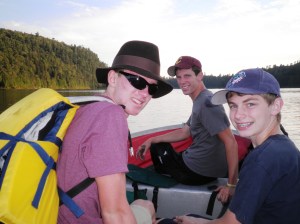
A few years ago on one of the Perry men’s annual Canadian fishing trips we deviated from tradition.
There’s a lake called Marianne we fish because we typically catch dozens of feisty Northern Pike. To get there requires crossing two lakes and taking two hikes through the Canadian wilderness while carrying our supplies.
This particular year we decided instead to drive over the old rutted logging trails to Marianne. I had done it once before so I was confident I would recognize which trails to take.
Three hours into a 30 minute drive we still had not found Marianne. I had a topographical map and instructions from our friend Craig Williams (ironically part of his instructions included discouraging us from driving).
I didn’t listen very well because I was confident we’d find Marianne with no problems.
Yet a number of times we’d arrive at a spot where I just knew Marianne had to be. I’d pull out my map and convinced myself that it had to be right there. When it wasn’t I’d tell the boys that it “might have dried up” or “been hidden by some trees” or some other foolish explanation.
This behavior is what experts call “bending the map.” It means to ignore reality and convince yourself that you are in the right place and that your map is wrong or the surroundings have changed (also called being lost).
“Bending the map” is trying to make reality fit what you want it to be instead of accepting it for what it is. It comes from stubbornness, pride, delusion or in my case simple optimism.
I’m often tempted to “bend the map”, to look at “the numbers” or a situation and believe it’s better than what it really is. It’s then that I have to remind myself of that three-hour tour of Canada so I can begin seeing things for what they are and then take the necessary action in face of true reality.
Are you bending any maps in your life? Don’t waste any more fishing time believing a false reality. Life is too short and there are too many fish to catch.
“Leadership is an Art”

“The first responsibility of a leader is to define reality. The last is to say thank you.” Max DePree in his book Leadership is an Art and repeated to me in my recent meeting with Roger Williams, Executive Director of Mount Hermon.
I’m very appreciative of Roger’s reminder of these words from this great book.
So when I got back to my office on Monday I grabbed my autographed copy and began to flip through it. As I did I realized two important but related facts concerning this book.
First, it is one of the best books on leadership I’ve ever read and was and is foundational in my leadership philosophy.
Second, I saw God’s hand directing Roger to bring Leadership is an Art back to my mind because of work the SpringHill Leadership team is doing in organizational planning.
So I took my copy with me on my trip this week knowing I now had to re-read it.
As I’ve finished it on my flight I’ve been blessed, challenged and affirmed once again because DePree puts into words and stories the heart of leadership. He sets an ideal that is noble, human, convicting and one I aspire to.
It is full of wisdom that is practical, philosophical and speaks to both heart and mind. And it is one of the most quotable books on leadership you will ever read.
It was written nearly 25 years ago so I was worried it was “dated” but I was not disappointed. It reads as contemporary, or maybe even more contemporary, today as it did when I first read it in the late 80’s. Both the truths and DePree’s writing style are timeless.
So I’ve ordered copies for my leadership team. We are going to read it together because it represents the kind of organization and leadership we aspire to.
If you want to be inspired to be the best leader you can be join us in reading (or re-reading) Leadership is an Art by Max DePree. It maybe the best book leadership book you’ll ever read.
Do What Only You Can Do!

For the second time in four months I have had someone share these words with me – “Do what only you can do.”
When I hear the same thing multiple times from multiple people in a relatively short period of time I know I need to listen.
The most recent time I heard these words were from Bob Nienhuis, a good friend and chair of the SpringHill board. We were meeting to go through the annual feedback the board provides me on my job performance.
These words struck hard because I had just heard them a few months earlier.
The first time was when I was teaching our adult Sunday school class at our church. A member of our class, Christine Giesler, responded to my sharing of the struggle I was having finding the time to accomplish work I was convinced (and still am) that God wanted me to do.
Christine told me the same thing Bob had said, “Do what only you can do.” Then she added an additional bit of wisdom in an effort to help me move to this place.
She said, “I’m sure you’re doing a lot of good and important things. But many of these things are things that someone else could do. By holding them and not sharing them with others you are robbing them of the opportunity to share in these important responsibilities and it keeps you from doing what only you can do.”
I’m thankful for this great advice from Christine and the reminder of that same advice from Bob of the ongoing work I’m doing – the work of making sure that, day by day, week by week, I’m doing what only I can do for SpringHill, my family and ultimately for His Kingdom.


